
News
Retailers must do more to promote healthy eating
12 Apr 2024UK retailers could play an even bigger role in helping consumers to make healthier food choices, according to Nesta, an innovation agency targeting social good.
Nesta is a non-profit organisation that – in its own words – “designs, tests and scales new solutions to society’s biggest problems, changing millions of lives for the better”. It brings together a range of experts and thinkers to address the defining issues facing the UK, from tax and economic growth to health and education.

Hugo Harper, Nesta’s mission director, recently penned a blog article, suggesting that the approach to food and health in the UK has been misguided, contributing significantly to the steep rise in obesity and associated health problems since the 90s.
Pivotal to this problem is the fact that the food that is readily available and affordable has changed, getting progressively unhealthier, and that UK supermarkets are playing a role in this, Harper believes.
How retailers and Government can play their part
Nesta conducted research (detailed in the company’s policy brief), which looked at 11 different grocery retailers across the UK. It found that while some chains are already close to the desired nutrient profile model (NPM) required to help consumers make healthier choices, many of the chains still have a long way to go to meet basic requirements.
Ingredients Network asked Nesta how supermarkets could be expected to step up to the challenge of reversing the trend towards unhealthy foods and what role the government might play to help solidify these efforts.
Lauren Bowes Byatt, Nesta’s deputy director of healthy life, said: “Some supermarkets will have further to go than others - although nine of the 11 supermarkets are already within two points of the target. Ultimately the businesses that are far away from their healthier competitors do have a role to play in shifting their offer for their customers.”
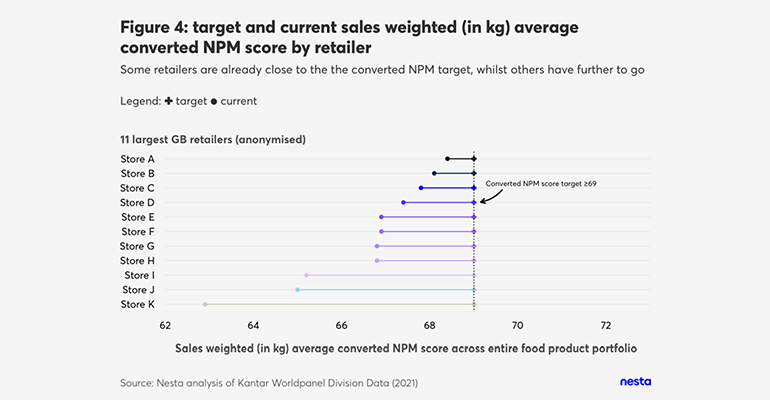 Pictured: Nesta Analysis of Kantar Workpanel Division Data 2021 | © Nesta
Giving consumers greater flexibility and value
On the back of its research, Nesta is recommending the introduction of initiatives such as two-for-one offers or discounting for healthier grocery items, to encourage the purchase of more nutritional foods, while simultaneously helping consumers to manage their household budgets.
“By setting a target for all big food retailers, they should pull in the same direction. It sets an industry wide goal but gives each supermarket the flexibility to choose their own tactics in order to meet the target, while keeping down the cost of a basket of food,” said Bowes Byatt.
“The tactics could include changing store and online layouts to avoid pushing less healthy products – such as those high in sugar – on consumers, purchasing and stocking a wider range of affordable healthy food, and using advertising and promotions like buy one get one free to make healthier items more affordable for families.”
While there is still room for several UK grocery retailers to do more to help in the push towards improving the health outcomes of consumers by encouraging them to buy more nutritional foods, the research also points to the fact that the government needs to play its part to help improve outcomes.
How Government can back up grocery retailers
Nesta research points to the fact that while grocery retailers are already on track to help improve the situation, the UK government needs to do its part to lend even greater gravitas to these efforts.
“…we believe that these health targets should be mandatory to encourage all retailers to act and create a level playing field. Our implementation plan provides government with a clear roadmap of how to put this proposal into practice,” said Bowes Byatt. “We propose that primary legislation is used, the Department of Health and Social Care oversees the design of the policy and the Food Standards Agency holds the powers to enforce compliance with targets and impose penalties, such as ones based on a percentage of annual turnover.”
Nesta says it is presently conducting further research into the NPM data it holds for UK food retailers and will soon by publishing more detailed information that will include the differences it found across different regions in the country, as well as income groups.
Related news

How younger consumers are redefining ingredient choices and rejecting brand loyalty
18 Nov 2025
Gen Z and millennial consumers’ preferences for transparency, functionality, and purpose are “redefining the very nature of consumption itself”, says SPINS.
Read more
Hybrid formats and flexible positioning to disrupt category norms in 2026
17 Nov 2025
Trend forecasters expect food and drink to move more fluidly across occasions, functions, and formats as consumers seek versatility, novelty, and convenience.
Read more
Empowering innovation in fortification and colouration
13 Nov 2025
Divi’s Nutraceuticals offers a large portfolio of innovative, high-quality ingredients for foods, beverages, and supplements, with bespoke solutions and expert support for product success.
Read more
From fruit to functional solutions: Meet Paradise Fruits at Fi Europe in Paris
13 Nov 2025
Paradise Fruits Solutions and Paradise Fruits Health will showcase their combined expertise in delivering innovative, fruit-based solutions to the food and beverage industry at the upcoming Fi Europe trade show (2-4 December 2025, Paris).
Read more
New UPF standard hoped to offer consumers ‘coherence and clarity’
10 Nov 2025
Ingredients companies are being urged to enter “a new era of partnership and innovation” following the launch of the industry’s first non-UPF verification scheme.
Read more
Cottage cheese makes a comeback as consumers call for cleaner labels
6 Nov 2025
From ice cream to dips and ready meals, cottage cheese is experiencing a renaissance as a high-protein, clean ingredient for health-conscious consumers.
Read more
Ingredient quantities mislabelled on popular protein bars, independent tests show
5 Nov 2025
Some popular protein bars contain more fat, carbs, and/or sugars than claimed on their labels, independent nutrition testing reveals.
Read more
Does promoting protein content push up plant-based sales?
27 Oct 2025
Promoting the protein content of meat-free products is a more effective sales strategy than adding carbon labels, a study of UK bakery chain Greggs suggests.
Read more
Agrigum Redefined FIBER
27 Oct 2025
Agrigum has transformed gum acacia into a natural, science-backed fibre that supports gut health, sustainability, and innovation across global food and nutrition applications.
Read more
Will Wicks’ Killer Bar harm the protein bar category?
23 Oct 2025
Joe Wicks’ deliberately dangerous protein bar is fuelling anti-UPF sentiment – but there are concerns that his messaging is misguided and could have unintended consequences.
Read more