
Sponsored Content
Protein Shifting and Enrichment with the use of Dry Grinding and Classifying
16 Feb 2023
Fine grinding - Fracturing of united cell structures with the aim of separating the starch granules from the proteins. The result are singular starch and protein granules as well as cell fragments gained from protein granules that partially contain starch granules.
Classifying - Efficient separation of the starch-protein-mixture into a coarse fraction with a high starch content and a fine fraction with a high protein content.
Worldwide, the food supply chain is being faced with change. On the one hand, the increasing growth of the worldwide population creates an increasing need for foodstuffs, including a supply of proteins. This increasing need cannot be covered by animal proteins/products alone, due to the land requirements of livestock. On the other hand, the growing demand by consumers for sustainable production methods must be taken into account. The criticism of the sustainability of animal products in particular is expanding: The land usage and water consumption as well as greenhouse gas emissions of these products, in comparison to those of cultivated crops, are many times higher. Alternative sources of protein are being sought, and they play an important role for meeting future population needs. In addition to plant products, mushrooms, algae or insects, can be placed in this category.
Currently, soy
is the most common of the crops used as a meat substitute based on plant
material. They are processed into isolates with high protein contents of >
80%. The typical method for obtaining these is wet extraction. The use of large
amounts of water, chemicals and energy for drying, makes this method a
laborious, complex and resource consuming process. An alternative process is
dry fractionation - a process that has been used to process flour for quite
some time. NETZSCH has successfully been able to carry over the experience
obtained from this process to the processing requirements of crops.
The goal of
the application is to achieve a protein rich fraction in which the portion of
protein is considerably higher than that of the initial material, by means of
grinding and subsequent separation.
The beans or
grains of a chosen crop are cleaned and dehulled, and afterward passed on for
dry grinding, the objective of which is to break up the cells and to separate
the starch granules from the proteins and fibrous cell parts. The most energy-efficient
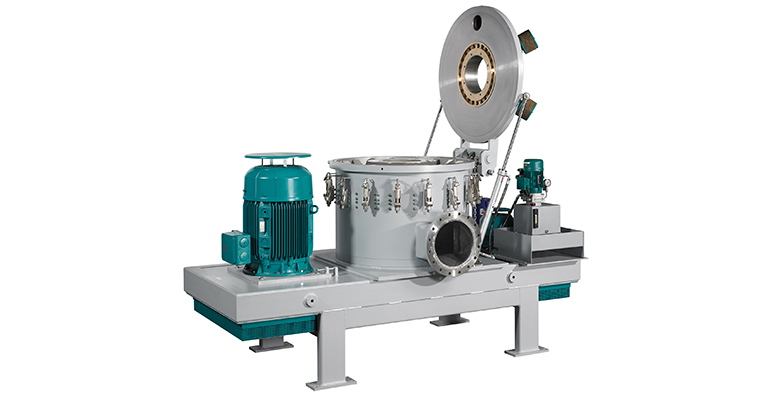
method for achieving this, is impact grinding using the NETZSCH classifier mill
type CSM.
The integrated classifier of this mill type assures that the coarse cell fragments remain in the grinding chamber for the duration necessary to destroy them, and to separate the starch and protein particles from one another. Only in this manner, can a high yield be achieved in the subsequent separation step, with an optimum amount of energy expenditure.
It is decisive for the separation step, that during the grinding process, the size difference between the protein and the starch granules remain as large as possible. Depending on the type of crop, the particle size of the protein is < 3 µm, whereas the size of the starch granules range from 3 µm to 40 µm. The force applied to the starch in the NETZSCH Classifier Mill, is far more gentle than that of a pin mill. This maintains the size difference between the protein and starch particles to the greatest possible extent, through which highest degrees of efficiency during separation are possible.
Separation is achieved using the NETZSCH High-Efficiency Fine Classifier CFS/HD-S. This classifier uses a stream of air to disperse the solid particles. Only through effective dispersion is it possible to optimally separate all of the particles and classify them according to size and/or weight. For this purpose, the ground product is passed into a ring gap, charged with air. The ring gap accelerates both particles into a circulatory motion, and the additional centrifugal forces separate them from one another. The particles are separated considerably more effectively, and thereby higher protein values and yields achieved, as compared to other design forms of classifiers. Once the processing parameters have been optimized to the product characteristics, on average, protein values of over 55% can be obtained, depending on the product.
Therefore, dry fractionation offers possibilities for cost effective, sustainable processing of premium quality products that have a high protein content. In addition, this type of process offers the invaluable advantage of flexible processing of diverse crops, simply by varying the processing parameters.
About NETZSCH Grinding & Dispersing
The
Grinding & Dispersing Business Unit, one of three business units of the
global NETZSCH Group, offers a comprehensive program for the many challenges in
mechanical process engineering. Here the Business Unit is primarily involved in
the areas of wet and dry grinding, mixing, dispersing, de-aeration and
classifying. The laboratory- and production-scale machines, as well as complete
production lines, are used in almost all areas of industry, such as the
forward-looking nanotechnology, the production of ink, minerals or foods.
The
bundling of processing know-how, our extensive machine program, solutions for
customer-specific problems and our global presence are unique and hence the
strength of the business unit.
Our
performance standards are high. We promise our customers Proven Excellence –
exceptional performance in everything we do, proven time and again since 1873.
Companies mentioned

Related categories
Related news

Benefits of using natural antioxidants in food
20 Nov 2025
The dietary habits of individuals are undergoing a transformation, with consumers increasingly seeking new, healthier, and higher-quality formulas. This shift signifies a growing awareness of food ingredients, including preservatives, additives, a...
Read more
Oat Barista: Innovation for game-changing beverages
20 Nov 2025
Oat Barista is a clean label, sustainable, and innovative drink base specifically designed to create the perfect foam in one single ingredient.
Read more
The Umami Renaissance: Clean Label & Cost Control with Ready-to-Use Fungal Bases
19 Nov 2025
Consumers demand authentic, rich flavor (Umami) and simple labels. The fungal protein market is growing at a 5.6% CAGR, offering manufacturers the solution: heat-stable, natural bases that eliminate prep costs and supply risks associated with raw wild ...
Read more
Azelis brings a taste of global street food innovation to Food Ingredients Europe 2025
18 Nov 2025
Azelis, the reference innovation service provider in the speciality chemicals and food ingredients industry, will showcase its latest Food & Nutrition innovations at Food Ingredients Europe (FiE) 2025, taking place from 2 to 4 December at Paris Expo Po...
Read more
PharmaLinea acquired by ANJAC Health & Beauty Group
18 Nov 2025
Ljubljana, 12.11. 2025 PharmaLinea, a leading provider of clinically supported private label food supplements has announced its acquisition by ANJAC Health & Beauty, a French industrial group that now comprises 17 complementary companies with R&D an...
Read more
The Heat Test: How Encapsulation and Bases are Ending the Multi-Billion Dollar Flavor Fade
18 Nov 2025
Flavor degradation during heat processing is a major financial risk in food manufacturing. In 2025, R&D is shifting to advanced encapsulation and heat-stable bases to protect volatile flavor compounds and ensure final product consistency.
Read more
Use Case Spotlight: Versatile Bases Solve Key Challenges in Ready Meals, Sauces, and Cheese
17 Nov 2025
Ready-to-use bases are the manufacturing solution for the $425 Billion RTE market. Our versatile ingredients solve core issues in three top categories: taste, clean-label compliance, and complex texture stability.
Read more
Hilmar Cheese & Whey Protein Awarded Medals
17 Nov 2025
Hilmar Cheese Company, Inc. was awarded top honors at the CheeseCon banquet celebrating the United States Championship Cheese Contest® on April 17, 2025.
Read more
Hilmar Cuts the Ribbon at New Dodge City Facility
17 Nov 2025
Hilmar Cheese Company, Inc., one of the world’s largest cheese manufacturers and a global supplier of high-quality whey ingredients was joined by Kansas Governor Kelly, U.S. Senator Moran and other federal, state and local officials to officially mark ...
Read more
Data Insight: Clean-Label Adoption Drives US$425 Billion Market, Prioritizing Simplicity and Natural Flavors
14 Nov 2025
The Clean Label Products market is projected to grow from US$425.32 billion in 2025 to over US$712 billion by 2034, driven by consumers prioritizing recognizability, minimal processing, and natural ingredient replacement.
Read more