
News
Impossible Foods heads for school cafeterias
17 May 2021Impossible Foods will be “widely entering” school breakfast and lunch programs in the fall of 2021, the company announced in a release. This foray into the public school system was made possible following Impossible Foods’ acquisition of the Child Nutrition Label from the United States Department of Agriculture (USDA) in April.
Child Nutrition Labels are voluntary food crediting statements that determine how much a particular food contributes to federal meal pattern requirements for nutritionally balanced meals for children. These labels are used by schools that participate in federally-funded lunch programs, which Impossible Foods is now eligible for.
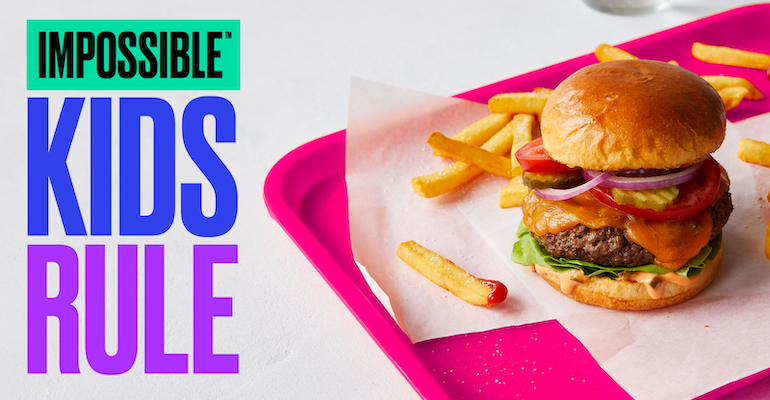
Already, the California company has begun to pilot the use of its plant-based protein in school districts in California, Washington and Oklahoma. In the program, participating schools are offering dishes on their menus, including Impossible street tacos, Impossible Frito pie and spaghetti with Impossible meat sauce. Furthermore, Food Navigator reported that the plant-based protein company has struck deals with private and charter schools across the U.S.
“Making Impossible products available everywhere people consume meat, which for kids often includes schools, is key to the mission of the company,” said Pat Brown, CEO and Founder of Impossible Foods in a statement.
Making its products available everywhere is a mission that the company is diligently working to fulfill. In recent months, Impossible Foods has put substantial effort toward its expansion efforts. Last July, the plant-based burger company announced it would be available in 2,100 Walmart stores across the country just days after it revealed its partnership with Trader Joe’s for nationwide retail sales. Between April and July of last year, the number of retail locations at which Impossible products were available expanded by eight times.
Stepping into the school lunch market gives the company yet another opportunity to dominate a distribution channel where plant-based meat has made little headway. Although 230 school districts in the U.S. are listed as Meatless Monday participants and processed meat has fallen out of favor with those planning school lunches, there have been few replacement solutions for the animal protein that has been taken off the menu. Should Impossible Foods expand its pilot program into full-fledged partnerships, there will be a large market into which to introduce its products. In the U.S. school served 5 billion lunches and 2.4 billion breakfasts in 2019, per USDA data.
While sizeable, selling to school districts to generate an additional revenue stream is only part of the appeal of entering school cafeterias. If Impossible Foods is able to introduce its products to children early, it has a chance to familiarize children with the flavor of its plant-based protein products and turn them into life-long consumers.
Related news

UK Government overhauls childhood obesity strategy
21 Nov 2025
The UK Government has announced a new package of measures designed to reverse the nation’s childhood obesity epidemic following the release of statistics revealing the scale of the crisis.
Read more
How younger consumers are redefining ingredient choices and rejecting brand loyalty
18 Nov 2025
Gen Z and millennial consumers’ preferences for transparency, functionality, and purpose are “redefining the very nature of consumption itself”, says SPINS.
Read more
New UPF standard hoped to offer consumers ‘coherence and clarity’
10 Nov 2025
Ingredients companies are being urged to enter “a new era of partnership and innovation” following the launch of the industry’s first non-UPF verification scheme.
Read more
Ingredient quantities mislabelled on popular protein bars, independent tests show
5 Nov 2025
Some popular protein bars contain more fat, carbs, and/or sugars than claimed on their labels, independent nutrition testing reveals.
Read more
Does promoting protein content push up plant-based sales?
27 Oct 2025
Promoting the protein content of meat-free products is a more effective sales strategy than adding carbon labels, a study of UK bakery chain Greggs suggests.
Read more
Supplement shoppers seek storytelling and science-backed suppliers
17 Oct 2025
Supplement consumers want specific health benefits that focus on prevention and personalisation, according to data from HealthFocus International.
Read more
Food fraud risks rise as brands fight economic and environmental headwinds
10 Oct 2025
Climate change, geopolitics, regulations, and demand for sustainable products are pushing up food fraud and adulteration risks, warns a world-leading food fraud expert.
Read more
The growing appeal of nutrient-dense food claims
2 Oct 2025
Nutrient-dense claims are rising as consumers reject the “empty calories” of UPFs in favour of products that provide meaningful nutrition with every calorie, Mintel data shows.
Read more
What does MAHA mean for the US nutraceutical industry?
30 Sep 2025
Industry associations have expressed mixed reactions to new policy directions on health and nutrition under the Make America Health Again (MAHA) banner.
Read more
Eco-Score labels improve consumer identification of sustainable foods
22 Sep 2025
The presence of a front-of-pack Eco-Score label improves consumers' accuracy in identifying sustainable food products from 52% to 72%, a study suggests.
Read more