
News
Cocoa Barometer 2018 report published
26 Apr 2018“Current approaches will not solve the problem at scale. Companies and governments need to acknowledge the urgency, and make a change. Efforts that cover less than 50% cannot be called ‘solutions’.”

The Cocoa Barometer 2018 report – a biennial review of the state of sustainability in the cocoa sector, assembled by NGOs around the world – has been released.
Cocoa growing communities, it says, particularly in West Africa, are facing poverty, child labour and deforestation that have been made worse by a rapid fall in prices for cocoa. Widely touted efforts in the cocoa industry to improve the lives of farmers, communities and the environment made in the past decade are, according to the report, having little impact: in fact, the modest scope of the proposed solutions does not even come close to addressing the scale of the problem. Smallholder cocoa farmers in Cote d’Ivoire – the world’s biggest cocoa producer, who are already struggling with poverty, have seen their income from cocoa decline by as much as 36% over one year. That fact reflects the world market price for cocoa, which saw a steep decline between September 2016 and February 2017. Farmers bear the risks of a volatile price; and there is no concerted effort by industry or governments to alleviate even a part of the burden of this income shock, the report claims. This price collapse was, it says, caused by overproduction of cocoa in past years, at the direct expense of native forests, claiming that this can be equally attributed to corporate disinterest in the human and environmental effects of the supply of cheap cocoa, and to an almost completely absent government enforcement of environmentally protected areas. In addition to often wrenching poverty for cocoa farmers, there is, according to the report, a host of other problems:+ An average cocoa farmer in Côte d’Ivoire earns only a third of what he or she should to earn a living income.+ More than ninety per cent of West Africa’s original forests are gone.+ Child labour remains at very high levels in the cocoa sector, with an estimated 2.1 million children working in cocoa fields in the Ivory Coast and Ghana alone. Child labour is due to a combination of root causes, including structural poverty, increased cocoa production, and a lack of schools and other infrastructure. Not a single company or government is anywhere near reaching their commitments of a 70% reduction of child labour by 2020.+ A “broken” market in which farmers have no real influence. While many of the current programs in cocoa focus on technical solutions around improving farming practices, the underlying problems at the root of the issues deal with power and political economy, such as how the market defines price, the lack of bargaining power farmers, market concentration of multinationals, and a lack of transparency and accountability of both governments and companies. “As long as poverty, child labour and deforestation are rife in the cocoa sector, chocolate remains a guilty pleasure,” said Antonie Fountain, co-author of the Barometer. “Current approaches will not solve the problem at scale. Companies and governments need to acknowledge the urgency, and make a change. Efforts that cover less than 50% cannot be called ‘solutions’.”Recommendations for action in the report include the following:- Make net income the key metric for all sustainability projects.- Commit to a sector-wide goal of achieving a living income.- Commit to a global moratorium on deforestation; focus on agroforestry and reforestation as environmental solutions.- Move from voluntary to mandatory requirements, on human rights as well as on transparency and accountability.- Develop sector-wide approaches at scale that address root causes to child labour.- Increase urgency and ambition to reflect the scale of the problems, and implement changes that also address issues around power and political economy, not just at technical levels.Related news

Oat Barista: Innovation for game-changing beverages
20 Nov 2025
Oat Barista is a clean label, sustainable, and innovative drink base specifically designed to create the perfect foam in one single ingredient.
Read more
Empowering innovation in fortification and colouration
13 Nov 2025
Divi’s Nutraceuticals offers a large portfolio of innovative, high-quality ingredients for foods, beverages, and supplements, with bespoke solutions and expert support for product success.
Read more
From fruit to functional solutions: Meet Paradise Fruits at Fi Europe in Paris
13 Nov 2025
Paradise Fruits Solutions and Paradise Fruits Health will showcase their combined expertise in delivering innovative, fruit-based solutions to the food and beverage industry at the upcoming Fi Europe trade show (2-4 December 2025, Paris).
Read more
New UPF standard hoped to offer consumers ‘coherence and clarity’
10 Nov 2025
Ingredients companies are being urged to enter “a new era of partnership and innovation” following the launch of the industry’s first non-UPF verification scheme.
Read more
Cottage cheese makes a comeback as consumers call for cleaner labels
6 Nov 2025
From ice cream to dips and ready meals, cottage cheese is experiencing a renaissance as a high-protein, clean ingredient for health-conscious consumers.
Read more
Bord Bia presents Irish dairy ingredient suppliers at Fi Europe
6 Nov 2025
Dairygold Co-operative Society, The Carbery Group, and Ornua Co-operative: Meet with sustainable producers of Irish dairy ingredients at Food ingredients Europe 2025, Hall 7.2 Stand M18.
Read more
Shorter drying time, sweeter success!
30 Oct 2025
Curious about cost-effective, sustainable and delicious candy making? Stefan Wessel reveals how Avebe’s solutions reduce drying time and energy use by up to 50%.
Read more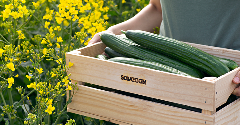
Could plant-based protection replace plastic packaging?
29 Oct 2025
Swedish foodtech company Saveggy has launched an additive-free plant-based protection for cucumbers, offering a waste-free packaging solution for fruit and vegetables.
Read more
Will Wicks’ Killer Bar harm the protein bar category?
23 Oct 2025
Joe Wicks’ deliberately dangerous protein bar is fuelling anti-UPF sentiment – but there are concerns that his messaging is misguided and could have unintended consequences.
Read more
Expanding boundaries in food & beverage innovation
23 Oct 2025
IMCD and FrieslandCampina Professional expand partnership to deliver Kievit® across EMEA, enabling brands to enhance quality and accelerate time-to-market for tomorrow’s food & beverage creations.
Read more