
News
Akua launches burger made from regenerative kelp
14 Jun 2021In a bid to take a slice of the plant-based burger market, New York-based Akua launched a burger made from kelp. This ocean-farmed seaweed burger also contains crimini mushrooms, pea protein, black beans, quinoa, and crushed tomatoes.
In addition to being entirely plant-based, the burger provides consumers other perks such as a hefty dose of vitamins A, B6, and K, as well as zinc, calcium, folate, potassium, and iron. At the same time, this vegetarian option is free from saturated fats, trans fats, and added sugar.
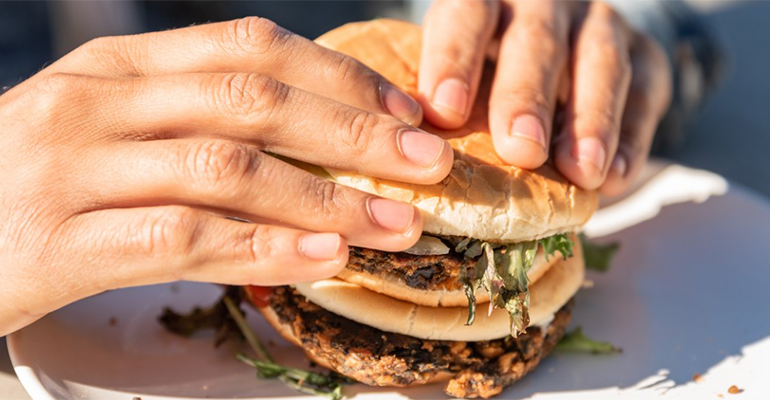
Currently, these kelp burgers are available online and are shipped frozen to their destination overnight. Each 12-pack retails for $48.99. Outside of direct-to-consumer retail, the kelp burgers are available at select restaurants across the nation, including Honeybee Burger and HULA’s in California, The Crystal in Florida and Lemon Press in Nantucket.
Akua has been selling kelp as a dried jerky snack since 2019, and this latest release indicates that seaweed is continuing to grow in popularity with consumers as an alternative to animal-based protein solutions.
Seaweed is a star of the sustainable protein movement. When farmed in the ocean, kelp is a zero-input crop, which means that it does not require water, fertilizer or any sort of man-made fields to flourish. Furthermore, kelp not only requires limited resources to grow, but it sequesters carbon from the atmosphere – nearly 200 million tons of greenhouse gas annually, according to the BBC.
“Ocean-farmed kelp is one of the most sustainable foods on the planet, and our goal at Akua is to introduce more people to its deliciousness, as well as its environmental and health benefits,” said company co-founder Courtney Boyd Myers. “We’re offering something better than a fake meat burger or a boring veggie burger, and we can’t wait for consumers to taste the difference.”
Over the last several years, seaweed has been rising on a tidal wave of popularity as consumers seek not only healthy alternatives but ones that give back to the environment. While seaweed offers a solution meeting both those credentials, it further provides a unique umami flavor and an opportunity to lower or replace salt content – both qualities that are perennially popular with consumers. Globally, the market for seaweed is expected to grow at a compound annual growth rate of 8.9% from 2018 to 2024, per data from Grand View Research.
With such a large jump expected for this category, plenty of companies have been looking to ride the rising tide. The Dutch Weed Burger from the Netherlands and Plantruption out of Ireland are making plant-based burger alternatives with different types of seaweed. Beyond burgers, seaweed has also made its way into a variety of different applications, including bread, pasta and jerky, all of which indicate that the product is versatile and may make it a novel investment for both consumers and investors.
Related news

Oat Barista: Innovation for game-changing beverages
20 Nov 2025
Oat Barista is a clean label, sustainable, and innovative drink base specifically designed to create the perfect foam in one single ingredient.
Read more
Nitrites: Pressure grows on UK to follow EU’s lead
20 Nov 2025
Pressure is growing on the UK to follow the EU’s lead after the bloc revised its regulations on the permitted levels of nitrites and nitrates in cured meats.
Read more
Empowering innovation in fortification and colouration
13 Nov 2025
Divi’s Nutraceuticals offers a large portfolio of innovative, high-quality ingredients for foods, beverages, and supplements, with bespoke solutions and expert support for product success.
Read more
Danone highlights digestive health as potential ‘tipping point’ for food industry
13 Nov 2025
Danone is betting on a food industry “tipping point” that will bloat the market for healthy products, particularly those related to gut health.
Read more
Standing Ovation and Bel scale up casein production from dairy co-products
11 Nov 2025
Foodtech company Standing Ovation has partnered with cheese specialist Bel Group to manufacture dairy serums for industrial-scale casein production via precision fermentation.
Read more
AI attraction means foodtech startups must ‘prove’ rather than ‘promise’
4 Nov 2025
Reports suggest that artificial intelligence (AI) is sucking investment from foodtech and agritech, but investors say the picture is complicated.
Read more
Will postbiotics become the go-to functional ingredient?
3 Nov 2025
Postbiotics show significant promise for the functional foods market due to their safety profile and beneficial bioactive properties, research suggests.
Read more
Meet the finalists of the Fi Europe Innovation Awards 2025
31 Oct 2025
Who made it to the shortlist of the Fi Europe Innovation Awards 2025? Read about the 23 companies making food and drink products healthier and manufacturing processes more efficient.
Read more
Penguin and Club bars no longer classed as chocolate
30 Oct 2025
Penguin and Club bars can no longer be classified as chocolate after the pladis-owned McVitie’s brands turned to cheaper alternatives amid the ongoing cocoa crisis.
Read more
Shorter drying time, sweeter success!
30 Oct 2025
Curious about cost-effective, sustainable and delicious candy making? Stefan Wessel reveals how Avebe’s solutions reduce drying time and energy use by up to 50%.
Read more